
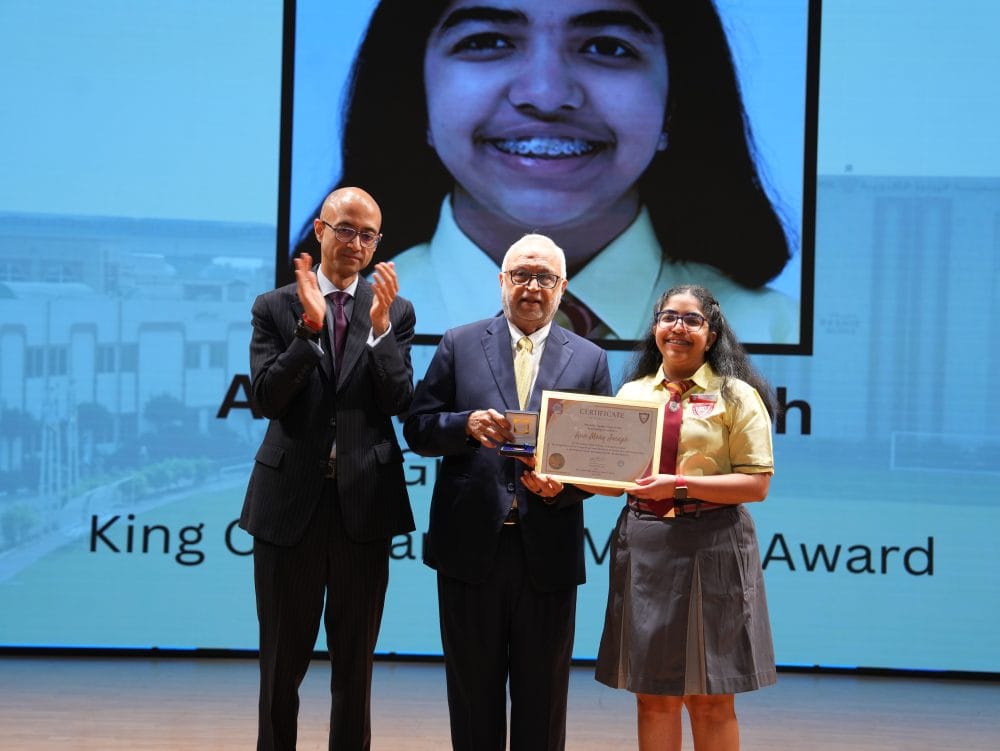
A King Constantine Medal Story – Ann Mary Joseph, Indian High School, Dubai
King Constantine Medal 2025: Ann Mary Joseph, The Indian High School, Dubai.
Described by her teacher at The Indian High School, Dubai, as a “visionary” and a natural leader with a clear eye on the future, Ann has been awarded her school’s King Constantine Medal this year, not only for her dedication to service but also for her innovative use of AI to connect and empower her school community. Ann explains what it means to receive the medal:
When I found out I had been selected to receive the King Constantine Medal, I was genuinely overwhelmed. It is such a significant recognition, and to be chosen from among so many dedicated, passionate students… felt surreal. But more than anything, it made me stop and reflect—not just on what I’ve done, but why I’ve done it.
To me, leadership is not about holding a position, it’s about seeing something that needs to change and being willing to take that first, sometimes uncomfortable step. I have always believed that real change does not begin in a loud room or with a formal announcement—it starts quietly, with a question. For me, that question has often been: What if we tried it differently?
A big part of my journey has been around AI and innovation. I have always been fascinated by how we can use technology not just as a tool for learning, but as a force for good—something that could bridge gaps, empower students, and make education more inclusive. So when I had the chance to propose an initiative that connected artificial intelligence with leadership training, I saw it not just as a project, but as a challenge: Could we make this meaningful for students across age groups, not just the tech-savvy few?
The programme we created was built on the idea that AI shouldn’t be intimidating or exclusive. We started with interactive workshops where students from Grade 5 all the way to Grade 12 were invited to explore tools like ChatGPT, text-to-image generation, and ethical decision-making using simulated AI prompts. I knew I wanted this to be more than just a demonstration—it had to be a conversation.
One of the most powerful moments for me was seeing Grade 6 students confidently presenting their own AI-powered solutions to real-life community problems. That was when I realised the initiative was no longer “mine”—it had become ours.
Winning the medal did not just celebrate the outcome, it recognised the collaborative journey—the young leaders who gave up their lunchtimes to plan events, the students who challenged our ideas and made them stronger, and the mentors who trusted us to take the lead.
Of course, the road hasn’t been smooth. Balancing innovation with ethics, especially in AI, means constantly asking hard questions: Are we excluding anyone? Are we creating dependency? Are we thinking long-term? These are not always easy conversations to have in a school setting, but they are necessary. I think the most valuable part of leading this work was learning that it is okay not to have all the answers, as long as you’re willing to listen and adapt.
Another key part of my role this year has been leading a group of around 70 student leaders from Grades 5–12. It’s a role I take seriously, not because of the title, but because of the ripple effect it creates. When a younger student finds their voice, takes initiative, or dares to present in front of a large audience for the first time, I see the impact of what we’re building.
Through my involvement with Round Square, with Model United Nations, and with our student-led innovation projects, I’ve connected with peers from schools across the UAE and beyond. We have shared ideas on everything from sustainability in urban schools to peer-mentoring models. These exchanges remind me constantly of the power of Internationalism—when we listen, we grow.
As we look ahead to RSIC 2025 in Dubai, I feel an enormous sense of gratitude. Not just for the recognition, but for the people who trusted me to lead, question, and create. The King Constantine Medal is not the end of a journey for me—it’s a call to do more, to think bigger, and to keep empowering others along the way.
If there’s one thing I would tell younger students starting their own leadership journey, it’s this: You don’t need permission to lead. You just need purpose.“