

Discovering Inquisitiveness in Round Square Schools
Inquisitiveness is key to the Round Square Discovery Framework. We discover it by making continuous enquiries in the pursuit of truth, exploring the world around us, and seeking out our place within it. We grow it through practice: testing boundaries, challenging assumptions, and maintaining a healthy scepticism when evidence is limited.
Making this discovery involves more than simply asking questions. It requires creating environments in which questioning becomes a shared language—a tool for communication, collaboration, and learning. Students learn to embrace uncertainty, recognising that there may not be one “right” answer, or sometimes no clear answer at all. Instead, the journey of discovery itself becomes a valuable process.
So what does this look like in practice? Here are some stories from the RS Community:
Questioning and Persistence
“Leadership… starts quietly, with a question. For me, that question has often been: ‘What if we tried it differently?’” explains Ann Mary Joseph from The Indian High School, Dubai, after being awarded the school’s King Constantine Medal for this year. Her initiative invited students from Grades 5–12 to explore artificial intelligence in inclusive workshops—focusing on both ethical implications and collaborative engagement.
“Seeing Grade 6 students confidently present their own AI‑powered solutions… the initiative was no longer ‘mine’—it had become ours,” says Ann.
Another King Constantine Medal recipient Trijal Sharma from Maria’s Public School in India founded TechBridge after meeting a student whose dreams were limited by lack of access to computers—despite wanting to be a software developer.
“How could we ask children to dream of a future they’ve never even seen?” He transformed that question into action, using Raspberry Pi units to empower students in underserved communities.
Trijal’s work, echoed by the sentiments of students lighting up with new confidence, shows inquisitiveness intertwined with empathy. It encourages schools to support student-led initiatives that blend enquiry with social impact.
Meanwhile, at The Shri Ram School, Aravali in India, Suhaani Sriram’s project to develop a flood alarm exemplifies how inquisitiveness can be built through persistence and experimentation. Faced with a real community challenge, she did not settle for easy answers. Instead, she tested her ideas repeatedly, learning through trial and error.
“I kept changing things until it actually worked,” Suhaani explained. “It was frustrating at times, but I learned so much by asking ‘Why isn’t this working?’ and trying again.”
This persistence is a key part of building inquisitiveness—teaching students that enquiry is a process rather than a moment of insight.
Baraza Leaders: British Overseas School, Pakistan and St George’s Diocesan School, Namibia
In Namibia and Pakistan, students at St George’s Diocesan School and British Overseas School are developing a spirit of inquisitiveness by leading conversations as Baraza Leaders. Their role involves creating safe spaces for open dialogue, asking thoughtful questions, and managing difficult topics with empathy.
Cheyenne, a Baraza Leader at St George’s, shared: “Being a leader here isn’t just about speaking up—it’s about listening carefully, being kind, and helping others find their voices.”
Grace, her peer, reflected on how the role pushed her beyond her comfort zone: “It takes bravery to hold a space where people might disagree or feel uncomfortable. But that’s where real understanding happens.”
“You really have to figure out what’s going to work and keep their attention.” Mariam from the British Overseas School put it simply: “You have to prepare properly — come with good questions and a plan.” Her classmate Sonia agreed: “If you have clear guidelines and interesting points, people want to talk.”
By encouraging students to navigate complexity and difference through conversation, schools build a spirit of inquisitiveness that values diverse perspectives and respectful enquiry.
Acts of Kindness: Windermere School
In the UK, Windermere School’s student-led “Acts of Kindness” campaign offered another approach to nurturing inquisitiveness—this time through empathy and reflection. They explored how kindness affected wellbeing, using surveys and real-time feedback to understand its impact.
Claire Holmes, Windermere School’s former Round Square Coordinator, observed: “The students started asking deeper questions about how kindness connects to community and mental health. It was as much about understanding people as it was about doing good deeds.”
One student explained, “When we did an act of kindness, I’d pause and think, ‘How does this make me feel? How might it affect others?’ It made me more curious about feelings and relationships.”
This project highlights how inquisitiveness can include ethical reflection and emotional awareness, encouraging students to question not only facts but also their own values and actions.
Global Collaboration
At SAI International School in Bhubaneswar, India, students developed inquisitiveness through a global storytelling initiative called “Story Relay – Pass the Baton.” Each participating Round Square school wrote a chapter in a collaborative story, building on the chapter before while keeping the theme and plot intact.
This activity encouraged students to ask questions like: “What happens next?”, “How can we develop the characters while staying true to the story?”, and “What ideas from other schools could we explore?” They had to listen closely, interpret others’ contributions, and experiment with new narrative directions, fostering curiosity, problem-solving, and creativity.
The project expanded across borders—India, Nigeria, Qatar, UAE, UK, and Pakistan—offering students the chance to explore diverse perspectives and storytelling approaches. By dramatizing and audio-recording their chapters, they further extended their inquiry into how stories could be expressed through voice and performance.
Students didn’t just learn about plot and characters—they learned to question, collaborate, and innovate, embodying inquisitiveness in a way that was both imaginative and deeply social.
RSIS South Africa July 2025
The RSIS Project in South Africa, hosted by Tiger Kloof Educational Institution in July 2025, provided a powerful environment for developing inquisitiveness through experience. Students from around the world came together to build a kindergarten in the rural village of Matlaneng, work alongside the community, and engage with local culture.
Katlego from Tiger Kloof Educational Institution in South Africa described the personal growth that came from the experience:
“At first, I worried about connecting with so many new people. But when I just started being myself, I realised people wanted to listen and learn from me too. It made me curious about their stories.”
Lucas, from New Zealand’s Whanganui Collegiate School, reflected on the friendships formed:
“We came as strangers from different countries, but we left with friendships I think will last a lifetime. Sharing stories about our cultures made me question what I thought I knew about the world.”
James, from RGS Surrey Hills in the UK, summed up the deeper meaning: “This isn’t about coming in to ‘save’ anyone. It’s about being part of something bigger, listening, and learning from people’s experiences.”
The physical work was demanding, but students felt it grounded their learning in reality. Esteban from Ermitage International School in France said: “Moving bricks and rocks was hard, but it was great to see our effort helping the community.”
The project also pushed students outside their comfort zones. Kennedy from Christ’s College in New Zealand reflected:
“Being without phones, living with people I’d never met, and learning about a different culture—it was scary, but it made me ask new questions about myself and others.”
Through shared work and conversation, students developed a more open, questioning mindset—one ready to listen, learn, and adapt.
Discovering our inquisitiveness is not about finding all the answers but fostering a mindset that is curious, questioning, and open to new ideas. Round Square Explorers model this spirit through innovation, dialogue, kindness, and shared experience. As schools consider how to nurture inquisitiveness, these examples offer practical inspiration. Tell us what you are doing in your school to discover and develop inquisitiveness.
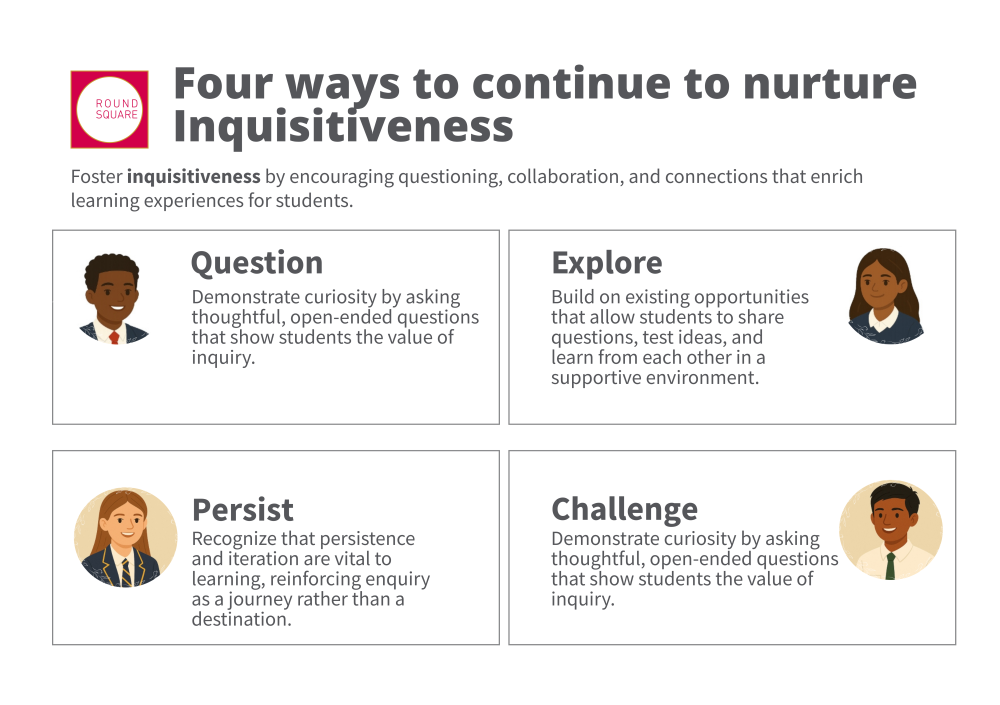
Four ways to build on what schools already do to nurture inquisitiveness
Across Round Square schools, inquisitiveness is already embedded in many classrooms, conversations, and community projects. The following ideas are not a starting point, but an invitation to extend and deepen what is already happening:
- Model open questioning
Continue to demonstrate curiosity by asking thoughtful, open-ended questions as part of everyday learning. When young people see respected adults exploring uncertainty and seeking multiple perspectives, they learn that questions are valued as much as answers. - Value the process, not just the product
Keep recognising persistence, iteration, and the learning that happens along the way, rather than only rewarding the “finished” result. This reinforces enquiry as a journey, not a one-off task. - Create spaces for collaborative exploration
Build on existing opportunities—discussion forums, cross-year projects, informal clubs—that allow students to share questions, test ideas, and learn from each other in a supportive environment. - Encourage respectful challenge
Keep fostering a culture where questioning assumptions, even long-held ones, is welcomed. Equip students to probe ideas constructively, listen actively, and adapt their thinking when faced with new evidence.
Already a member of Round Square? Click here for specific resources.
Find out more about becoming a member of Round Square here.